


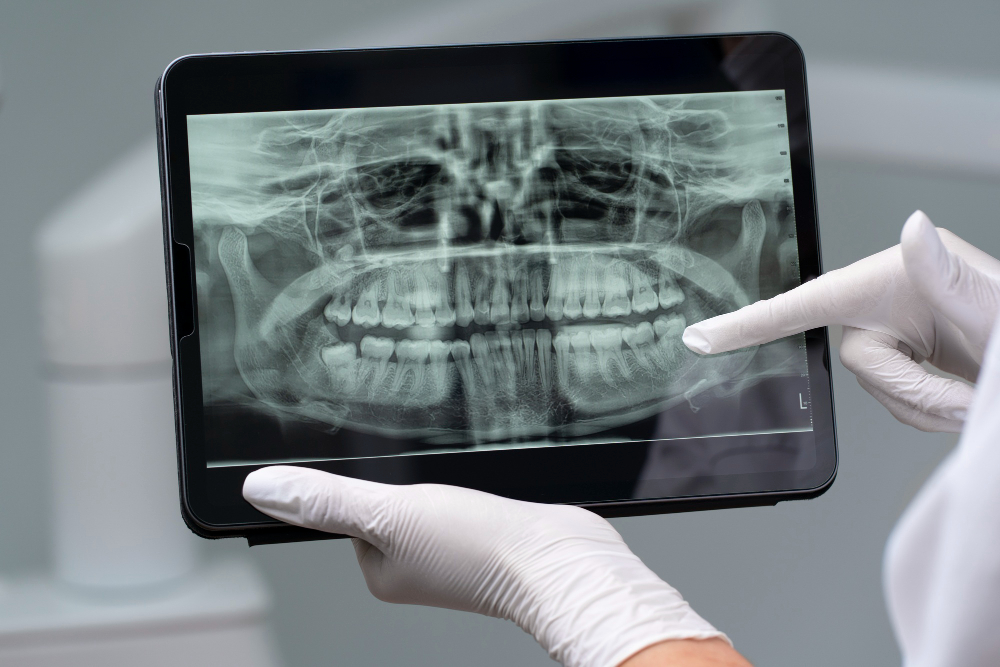
Most people think of dental visits as cleanings and checkups, but there is another part of your appointment that often answers the biggest questions about your oral health. If you have ever searched for “dental x-rays near me”, you were likely trying to understand what is happening beneath the surface of your teeth and gums.
Dental X-rays play an important role in detecting issues that are not visible during a standard exam. From routine bitewing images to advanced 3D scans, each type of X-ray helps evaluate different aspects of your teeth and jaw.
At our office, we use imaging as part of our general & family dentistry approach to get a clearer picture of your smile. X-rays help us spot issues early, track changes over time, and guide treatment decisions with more accuracy. There are several types of dental X-rays, and each one plays a specific role depending on what we need to evaluate.
What Dental X-Rays Show and Why They Matter
Dental X-rays are images that allow us to look beneath the surface of your teeth and gums. They help identify cavities, infections, bone changes, and other concerns that may not cause symptoms right away. In simple terms, X-rays help us catch problems early and plan the right treatment.
These images also allow us to track changes over time. By comparing current and past X-rays, we can monitor your oral health and adjust your care as needed. This is an important part of maintaining consistent dental care that Madisonville patients can rely on.
Intraoral X-Rays: The Most Common Type
Intraoral X-rays are taken inside the mouth and are the most frequently used type during routine visits. These images offer a detailed view of individual teeth and the surrounding bone.
Bitewing X-rays are one of the most common forms. They are used to check for decay between teeth, which is an area that cannot be seen during a visual exam. Periapical X-rays focus on a single tooth from the crown to the root, making them useful for identifying infections or issues below the gumline.
Occlusal X-rays are another type, often used to evaluate tooth development or changes in the floor of the mouth. These are sometimes used for younger patients as their teeth continue to develop.
Extraoral X-Rays: Looking at the Bigger Picture
Extraoral X-rays are taken outside the mouth and are designed to capture a broader view of the jaw and surrounding structures. These images are helpful when we need to assess areas beyond individual teeth.
A panoramic X-ray creates a single image of the entire mouth, including the upper and lower jaws. This type is often used to evaluate wisdom teeth, jaw alignment, and overall structure.
Another form is the cephalometric X-ray, which shows a side view of the head and jaw. This is commonly used in orthodontic planning to understand how the teeth and jaw align over time.
3D Dental Imaging with CBCT Scans
Cone Beam Computed Tomography, often referred to as CBCT, is a more advanced form of imaging that creates a three-dimensional view of the teeth and jaw. This technology is used for more complex planning, such as dental implants or detailed evaluations of bone structure.
Unlike standard X-rays, CBCT scans offer depth and detail that allow for more precise treatment planning. This makes them a valuable tool when accuracy is especially important.
Although not needed for every patient, this type of imaging plays an important role in certain procedures and helps guide treatment decisions with greater confidence.
When Dental X-Rays Are Typically Needed
X-rays are not taken at every visit without reason. The frequency depends on your dental history, current condition, and overall risk for issues such as decay or gum disease.
For many patients, X-rays are taken every one to two years as part of routine care. Patients with ongoing concerns or a higher risk of dental problems may need them more often so we can monitor changes more closely.
These decisions are always based on your individual needs, helping balance preventive care with patient comfort.
Are Dental X-Rays Safe?
One of the most common concerns patients have is safety. Dental X-rays use a very low level of radiation, and modern digital systems reduce exposure even further compared to older methods.
We only recommend X-rays when they are needed to support your care. Protective measures are also used during the process to keep exposure as low as possible.
In simple terms, dental X-rays are considered safe and are an important part of diagnosing and monitoring oral health.
How Dental X-Rays Help with Treatment Planning
X-rays are not just about finding problems. They also help us plan treatments with greater accuracy. For example, if a patient needs a filling, crown, or implant, imaging helps us understand the exact condition of the tooth and surrounding bone.
This level of detail allows for more precise recommendations and helps avoid unnecessary procedures. It also gives patients a clearer understanding of what is happening and why certain treatments are recommended.
Using the right types of dental X-rays, we can create a treatment plan that is based on real information rather than guesswork.
Choosing the Right Dental Office for Imaging in Mandeville
If you’re searching for “dental X-rays near me”, it is best to find a dental office that focuses on both technology and patient comfort. Modern imaging equipment, combined with a thoughtful approach, can make the process quick and easy.
At Grand Family Dentistry, we use updated imaging techniques as part of a complete approach to dental care. Our goal is to make each visit straightforward, while giving you a clear understanding of your oral health.
Patients often appreciate knowing what to expect and having their questions answered before imaging begins. This helps make the experience more comfortable from start to finish.
Schedule Your Visit with Our Team Today
At Grand Family Dentistry, our office focuses on thorough evaluations, clear communication, and care that fits your needs. From routine exams to more advanced treatment planning, we use imaging to guide every decision and help you maintain a healthy smile over time. Contact us today to schedule a visit.
FAQs
How often do I need dental X-rays?
Most patients need dental X-rays every one to two years. Your dentist may recommend them more often if you have ongoing concerns or a higher risk of dental issues.
Do dental X-rays hurt?
Dental X-rays are not painful. Some patients may feel mild discomfort from holding the sensor in place, but the process is quick.
Are dental X-rays safe for children?
Yes, dental X-rays are safe for children. They are often used to monitor growth and development and to detect issues early.
What is the difference between 2D and 3D dental imaging?
Standard X-rays provide two-dimensional images, while CBCT scans create a three-dimensional view. 3D imaging is typically used for more complex cases that require detailed planning.
Can I skip dental X-rays if I feel fine?
Even if you do not have symptoms, dental X-rays can detect issues early. Skipping them may allow problems to go unnoticed until they become more serious.